Ang pag-abot sa mga masasarap at matatamis na mga pangarap atbp. samu't sari ng buhay....
[Making dreams deliciously sweet realities plus other tidbits of life....]
Over the last year, I’ve gradually moved more and more towards making my own food at home. There are several reasons for this: it tastes better, it reduces preservative intake, it’s more nutritious, and it’s often substantially cheaper than what you find in the store. It does take time, but once you get used to it, most food preparation doesn’t take much more time than going to the store, buying it, taking it home, popping it out of the package, and following the directions.
I chanced upon this very good article. There are indeed many ways to enrich family life...and that includes cooking and baking together....A happy kitchen life makes a healthy, happy family. It is eating together, sharing the food, how much more if you make the food together. Go through the list and you will find food everywhere....sharing and enjoying the goodness of food together as a family. It is in sharing that our bonds get stronger....
I now say:
"The family the prays (and EATS and cooks and bakes) together stays together...."
Spending time with family can be lots of fun. (Photo courtesy of Jeremy Barwick)
Do you remember to have fun every day?
I’m sure you remember to brush your teeth, to eat, and to go to work. I’m confident you have a handwritten or a technology-based to-do list that you carefully go through each day. But if you read this blog, it means you want more from your life. You want to de-stress, to be present, to enjoy the journey instead of rushing through it like a madman.
Having fun with your family, especially the simple kind of fun – the one that doesn’t drain you emotionally and financially, is a wonderful way to relax and enjoy life. And in times of economic uncertainty, it is especially important to enjoy family time that does not involve spending lots of money. Here are 30 ideas for high-quality, low-cost, stress-free family fun.
5. Go out for a leisurely Sunday brunch. Many restaurants offer great Sunday buffets, and prices these days are more reasonable than ever. Kids often eat free of charge. Although buffets can be challenging if you’re trying to lose weight, or maintain your goal weight, once in a while is probably OK. Since kids usually have very limited choices as far as food goes – they eat what we give them – they really appreciate the selection and choice a buffetoffers.
6. Just talk. The older my kids are, the more interesting our conversationsbecome.
7. Try tongue twisters. Last week when we waited forever for the check to arrive at a restaurant, my husband started a tongue twisters game. We laughed so hard, I nearly choked. My favorite tongue twister: “She sells seashells by the seashore.” Repeat three times, FAST!
9. Create a story together. Each family member gets to add one sentence at a time. These stories can be seriously funny, especially if one of the kids happens to be in a silly mood.
13. Visit the library. Browse the children’s books together. Read them a story or two. Listen to Story Time if the library offers it. Browse the grownups’ selection too: it’s good for your kids to see you’re interested in books.
15. Play a board game. I don’t know about you, but my husband and I play to win. We don’t believe in letting the kids win. After all, their friends won’t let them win. The good news (or bad news, depending on your point of view): they often win anyway!
16. Go for a hike. We love to go to a local park that has beautiful redwood trees in addition to a small playground and a shaded picnic area.
17.Go to the museum. If your kids are younger than 5, take them to the children’s museum. If they are older, they can probably handle an hour or two in a “real” museum. A natural history museum is great, but many kids enjoy modern art museums as well. Many museums are free of charge for kids under 12, and many offer free admission for the entire family on monthly “family days.”
19. Go to the movies. While going to the movies is not as cheap as it used to be, matinee tickets are usually reasonably priced. It’s entirely possible to find PG-rated movies that are appropriate for elementary school kids yet are fun (or at least not mind-numbingly boring) for the grownups. During winter break we took the kids to see “Marley and Me” and “Bedtime Stories.”
20. Make breakfast foods for dinner, together. It never fails to make the kids happy. We like to make pancakes together. When they’re ready, we decorate them with berries to make fun “faces.” If your kids have milk and fruit with those homemade pancakes, it’s a pretty balanced meal. And if you’re really brave, try making whole-wheat pancakes.
21.Go to the beach. The beaches here in Northern California are cold and windy, even in summertime, and very rocky. But even though they don’t provide the classic beach experience, we love to go tidepooling. We often manage to spot interesting sea creatures and shells.
23. Jump rope. We do it outside in the yard in summer and inside during the winter. My kids are already experts. I’m still learning, or rather relearning.
24. Make the most of power outages. During a recent power outage, we all sat together in the kitchen. Since we were bored (no technology!) and had to use candlelight to light the kitchen, we used the candles to make s’mores. Seriously. It was one of our best nights ever. More tips for making indoor s’mores here.
25. Exercise together. I exercise at home using a yoga mat. My kids love to watch me exercise and they love even more trying to imitate what I’m doing on our extra mat.
26. Dance together. Play some loud music and go crazy with the moves. Don’t tell anyone, but I love to dance to ABBA music.
27. Bake homemade bread. You can use a bread machine if you have one, or you can knead the dough by hand. This takes time and is great for a winter day when you’re inside anyway. There’s nothing like the smell of breadas it’s baking, and there’s nothing like eating it fresh with homemade butter on top. Try this bread recipe. To make homemade butter, simply whip heavy cream with a pinch of salt until it turns into butter. Separate it from the remaining liquid (buttermilk) and spread on the freshly baked bread.
28. Write letters to the grandparents. Even if they live nearby, they will love getting letters from their grandchildren. If you join your kids and write a few words too, you will not only set a great example for your kids but will also make your parents very happy.
29. Read a book together. You can read to your child, or she can read to you, or you can simply snuggle together, each of you reading her own book.
30.Watch TV together. TV is not just a convenient babysitter: it can be an opportunity to share an experience with your kids. Once in a while I join my kids when they watch one of their favorite TV shows. They snuggle close to me, and whenever something funny happens on the show, they watch me closely to make sure I get it. When we’re done watching, we talk about what we saw. I often use it as an opportunity to talk about advertising, since there’s so much of it these days aimed at children.
rugelach, ruggelach, rugulah - pastry
made with a cream cheese dough and different fillings (as raisins and
walnuts and cinnamon or chocolate and walnut and apricot preserves)
[http://www.thefreedictionary.com/pastry] pastry
noun tart, Danish (pastry), pasty, tartlet high fat foods such as cakes and pastries see cakes and pastries
Types of pastry
choux pastry, filo pastry, flaky pastry, hot water pastry, pâte brisée, pâte feuilletée, pâte sucrée, puff pastry, rough puff pastry, shortcrust pastry, suet pastry
[http://en.wikipedia.org/wiki/Pastry] (Photo by flickr.com and today.ucla.edu.com)
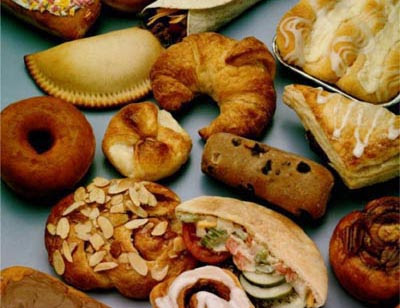
Pastryis the name given to various kinds of baked goods
made from ingredients such as flour, butter, shortening,
baking powder or eggs.
Small cakes, tarts and other sweet baked goods are called
"pastries".
Pastry may also refer to the dough from
which such baked goods are made. Pastry dough is rolled out thinly and
used as a base for baked goods. Common pastry dishes include pies, tarts and quiches.
Pastry is distinguished from bread by
having a higher fat content, which contributes to a flaky or crumbly
texture. A good pastry is light and airy and fatty, but firm enough to
support the weight of the filling. When making a shortcrust pastry, care must be taken to blend the fat and
flour thoroughly before adding any liquid. This ensures that the flour
granules are adequately coated with fat and less likely to develop gluten. On
the other hand, overmixing results in long gluten
strands that toughen the pastry. In other types of pastry, such as Danish pastry and croissants, the characteristic flaky texture is
achieved by repeatedly rolling out a dough
similar to that for yeast bread, spreading it with butter,
and folding it to produce many thin layers of folds. Many pie recipes involve blind-baking the pastry before the filling is added. Pastry dough may be sweetened
or perhaps unsweetened.
Main types of
pastry:
(Photos by howstuffswork.com, en.wikipedia.org, Ian Shortman)
Shortcrust pastry Shortcrust, or short, pastry is the simplest and most common pastry. It is made with flour, fat, salt, and water. The process of making pastry includes mixing of the fat and flour, adding water, and rolling out the paste. It is cooked at 180°C and the result is a soft, tender pastry. A related type is the sweetened sweetcrust pastry.
Flaky (or rough puff) pastry Flaky pastry is a simple pastry that expands when cooked due to the number of layers. This is perfect if you are looking for a crisp, buttery pastry. The “puff” is obtained by beginning the baking process with a high temperature and lowering the temperature to finish.
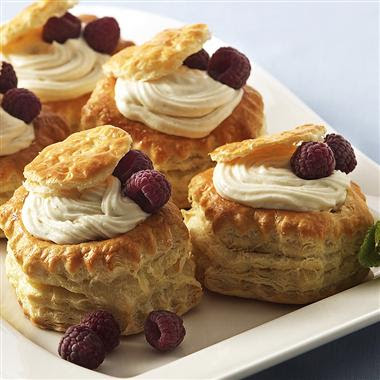
Puff pastry Puff pastry has many layers that cause it to expand or “puff” when baked. Pastries are made using flour, butter, salt, and water. Pastry rises up due to the combination and reaction of the four ingredients and also from the air that gets between the layers. Puff pastries come out of the oven light, flaky, and tender.
Choux pastry Choux pastry is a very light pastry that is filled with cream. The pastry is filled with various flavors of cream and is often topped with chocolate. Choux pastries can also be filled with things like cheese, tuna, or chicken to be used as appetizers.
Phyllo (filo) pastryPhyllo pastries are usually paper-thin and greatly stretched. They involve several stretched out layers and are wrapped around a filling and brushed with butter. These pastries are very delicate and can break easily.
Background and History:
(Photos by en.wikipedia.org, bakingbites.com, flickr.com)
Pastries go back to the ancient Mediterranean almost paper-thin
multi-layered baklava and filo. Medieval Europe took on pastry making
after the Crusaders brought it back.
French and Italian Renaissance chefs eventually perfected the Puff
and Choux pastries, while 17th and 18th century chefs brought new
recipes to the table.These new pastries included brioche,
Napoleons, cream puffs, and éclairs. French chef Antonin Careme reportedly was the first
to incorporate art in pastry making.
European traditions of pastry-making is often traced back to the
short crust era flaky doughs that were in use throughout the
Mediterranean in ancient times. These recipes were popularized in
Western Europe by Crusaders returning home.
In the Mediterranean, the Romans, Greeks and Phoenicians all had
filo-style pastries in their culinary traditions. There is also strong
evidence that the ancient Egyptians produced pastry-like confections. It
is very possible that Egyptians made and ate pastries. They had
professional bakers that surely had the skills to do so, and they also
had needed materials like flour oil and honey. In the plays of
Aristophanes, in 5th century BC, there are mentions of sweetmeats
including small pastries filled with fruit. The Romans used flour, oil
and water to make pastries that were used to cover meats and fowls. They
did this during baking to keep in the juices, but this was not meant to
be eaten by people. A pastry that was meant to be eaten was a richer
pastry that was made into small pastries and contained eggs or little
birds. It was often served at banquets. Greeks and Roman both struggled
in making a good pastry because of the fact that they both used oil in
the cooking process and oil causes the pastry to lose its stiffness.
In medieval North Europe they were able to produce nice, stiff
pastries because they cooked with lard and butter. There were some
incomplete lists of ingredients found in medieval cookbooks, but no
full, detailed versions. There were stiff, empty pastries called coffins
or 'huff paste', that were eaten by servants only and included an
egg yolk glaze to help make them more enjoyable to consume. Medieval
pastries also included small tarts to add richness to the snack. It was
not until about the Mid 16th century until actual pastry recipes showed
up.These recipes were adopted and adapted over time in various European
countries, resulting in the myriad of pastry traditions known to the
region, from Portuguese "pastéis de nata" in the west to Russian
"pirozhky" in the east. The use of chocolate in pastry-making in the
West, so commonplace today, arose only after Spanish and Portuguese
traders brought chocolate to Europe from the New World starting in the
1500s. Many culinary historians consider French pastry chef Antonin
Carème (1784–1833) to have been the first great master of pastry making
in modern times.
Pastry-making also has a strong tradition in many parts of Asia. Chinese pastry is made from rice, or
different types of flour, with fruit, sweet bean paste or sesame-based
fillings. Beginning in the 19th century, the British brought
western-style pastry to the far east, though it would be the French
influenced Maxim in the 1950s that made western pastry
popular in Chinese-speaking regions starting with Hong
Kong. Still, the term "Western Cake" (西餅) is used to differentiate
between the automatically assumed Chinese pastry. Other Asian countries
such as Korea have traditionally prepared pastry-confections such as
tteok, hangwa, and yaksi with flour, rice, fruits, and regional specific
ingredients to make unique type desserts. And Japan also has
specialized pastry-confections better known as mochi and manju.
Pastry-confection that originate in Asia are clearly distinct from those
that originate in the West that are generally much sweeter.
Definitions of Terms:
(Photos by slamchowder.com, mccormick.com, flickr.com)
Pastry A mixture of flour, fat, possibly egg and sugar, the fat usually dispersed as small solid globules coated with flour and the whole brought together with liquid prior to shaping and baking. There are many types of pastry. Pastry bag or Piping bag An often cone shaped bag that is used to make an even stream of dough, frosting, or flavored substance, to form a structure, decorate a baked good, or fill a pastry with a custard, cream, jelly, or other filling. Pastry board A square or oblong board preferably marble but usually wood on which pastry is rolled out. Pastry brake Opposed and contra-rotating rollers with a variable gap through which pastry can be worked and reduced in thickness for commercial production. A very small version is used domestically for pasta production. Pastry case An uncooked or blind baked pastry container used to hold savory or sweet mixtures. Pastry cream Confectioner's custard. An egg and flour thickened custard made with sweetened milk flavored with vanilla. Used as a filling for flans, cakes, pastries, tarts, etc. The flour prevents the egg from curdling. Pastry cutters Various metal or plastic outlines of shapes, e.g. circles fluted circles, diamonds, ginger bread men, etc. Sharpened on one edge and used to cut out corresponding shapes from biscuit, scone, pastry, or cakes mixtures. Pastry blender A kitchen implement used to properly combine the fat and flour. Usually constructed of wire or plastic, with multiple wires or small blades connected to a handle.
Pastrychef
(Photo by blackberrycool.com, flickr.com, pillsbury.com, wilyeastblog.com, Palladian.com)
Those who make pastries professionally are known as either bakerspastry chefs, depending on whether they produce
pastries for a bakery or a restaurant.
Pastry chefs use a combination of culinary ability and creativity in
baking, decoration, and flavoring with ingredients. Many baked goods
require a lot of time and focus. Presentation is an important part of
pastry and dessert preparation. The job is often physically demanding;
requiring attention to detail and long hours. They are also responsible for creating new recipes to put on the menu.
Pastry chefs work in restaurants, bistros, large hotels, casinos and
bakeries. Pastry baking is usually held in a slightly separate part from
the main kitchen. This section of the kitchen is in charge of making
pastries, desserts, and other baked goods.
(Photos by http://en.wikipedia.org, Simon Lee Bakery)
More interesting information via :
http://www.pfisterconsulting.com/history.htm
I got a confession to make. I am food addict, over-indulgent! I crave for anything especially sweets, chocolates, cakes, ice cream, strawberries, halo-halo, leche flan, banana Q, breads, pasta, Nasi Goreng....tell me what you got in your fridge ;-D. Thank heavens for I got my mum's genes, I can gain and lose pounds that easy and quick.
I am here to share with you my food recipe collection (almost forgotten in a corner of my room) and search for new, exciting recipes, meet good people, and discover more about the world of baking. I am no professional baker or chef (just a wanna-be for now) but we'll get there in time. In sha Allah. Afterall, DREAMS just got to start somewhere, and it starts right here, right now! Meantime enjoy this food journey with me among other stuff....amigos to the kitchen!
[Thank you for visiting my blog,you're always welcome to come by! Feel free to dig deep into the posts, much treasures there. And leave your comments, I'd appreciate your words....]
[P.S. Borrowed articles/photos can be deleted anytime, please advise.Thank you.]